
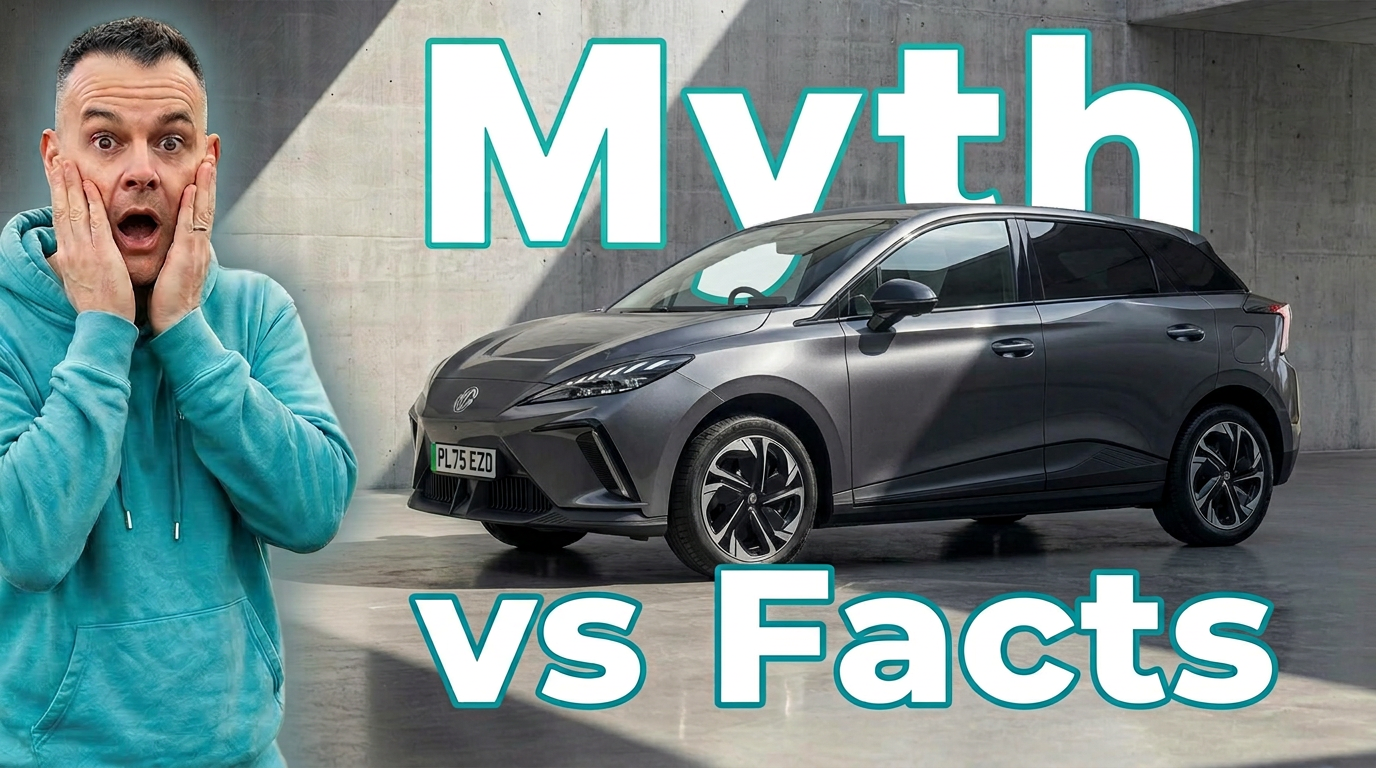
Electric cars: 9 myths North West drivers still believe in 2026

Fears people face around EV’s: The Short Answer
Most of the big worries about electric cars is “they'll die in a few years, they cost a fortune to charge, you'll be stranded looking for a plug” are now years out of date. In 2025, nearly one in four new cars sold in the UK was fully electric (473,348 of them, says the SMMT). That's not early adopters anymore. That's your neighbours.
So let's deal with the nine things people still get wrong! Grouped by what actually keeps them up at night. 1)The money. 2) Whether they could live with one. 3) And whether it's even worth the bother.
01 - First, the money worries
❌ Myth 1
"The battery will be dead in a few years"
RealityA typical EV battery still holds around 82% of its capacity after eight years and it's under warranty the whole time.
This is the worry that stops most people, and it's the one the data has most thoroughly flattened. Telematics firm Geotab studied more than 22,700 electric vehicles and found batteries lose an average of just 2.3% a year. After eight years, that's roughly 81.6% capacity left. Most packs are expected to last 10–20 years, or well past 150,000 miles.
And there's a safety net under all of it: nearly every manufacturer guarantees the battery for 8 years or 100,000 miles, to at least 70% capacity. So even in the worst case, you're covered for the best part of a decade.
Put it this way - your phone loses more capacity in two years than a modern EV loses in five.
❌ Myth 2
"Charging costs as much as petrol now"
RealityCharge at home and you'll pay a fraction of petrol. Charge only on motorway rapids and the gap closes so it depends entirely on how you charge.
Here's the honest split. Charge at home overnight on an EV tariff and a full top-up costs around £8 for 200+ miles - as little as 2p a mile (Energy Saving Trust). The same miles of petrol? The thick end of £45. Even on a standard home rate you're looking at 5–6p a mile versus about 17p for a 40mpg petrol car (stated by Carwow, using RAC fuel prices).
Now the catch we promised you. If you only ever use rapid public chargers, the maths tightens. Which? found that at 47p per kWh some EVs cost around 18.5p a mile - a touch more than petrol. So: home charger, and an EV is dramatically cheaper. No driveway and reliant on public rapids? Do your sums first.
100 miles of driving | Rough cost |
|---|---|
EV, home off-peak tariff | £2–£6 |
EV, standard home rate | £5–£6 |
EV, public rapid charger | £15–£18 |
Petrol car (~40mpg) | £16–£17 |
Indicative 2025–2026 figures; they move with energy and fuel prices.
❌ Myth 3
"They're far too expensive to buy"
Reality New EVs do still cost more up front but the used market has changed everything.
We won't pretend otherwise: like-for-like, a new EV often costs 15–25% more than its petrol twin. That's the real catch. But two things shift the picture.
First, you claw a lot of it back through lower running and servicing costs (fewer moving parts, no oil changes) over three or four years. Second (and this is the big one) the used EV market has exploded. A record 86,943 used electric cars sold in just the first quarter of 2026, up 32% on the year before (says Zapmap). A one- or two-year-old EV is now within reach of plenty of buyers who'd written one off as a luxury.
02 - Then, the "could I actually live with it?" worries
❌ Myth 4
"EVs can't do proper distances"
RealityPlenty now do 250+ miles on a charge, and the longest exceed 400. Range anxiety is largely a 2018 problem.
Real-world motorway figures run lower than the official WLTP number — usually 10–20% lower, more in the cold. But for the journeys most of us actually make, range stopped being the constraint a while ago. Be honest about your own driving: regular 300-mile winter motorway runs? Check the real-world range carefully. School run, commute, the odd weekend away? You'll barely think about it.
Range anxiety is the number one thing that stops people from making the switch to EV, affecting approximately 73% of potential EV buyers. And many of our clients always say that there is no where to charge their EVs. Well...we would like to prove you wrong!
75% of current EV drivers in the UK says the never have range anxiety and they always find a charger for their EVs - study completed in 2025. Range anxiety is slowly being proven to be most psychological and 85% of drivers say their range anxiety vanishes after just one week of ownership.
❌ Myth 5
"There's nowhere to charge"
RealityMost charging never happens in public. It happens on your driveway while you sleep.
You wake up to a "full tank" every morning, which beats queuing at a petrol station in the rain. Public charging matters most for long trips, and that's exactly where the network has filled in fastest - services, supermarkets, retail parks. An app like Zapmap shows live availability before you set off. Plan your first couple of long runs; after that it's second nature.
❌ Myth 6
"Charging takes all day"
RealityA rapid charger does 10–80% in roughly 20–40 minutes. A coffee, not an afternoon.
At home you're not watching it at all, it tops up overnight. On the road, here's a tip worth knowing: that last 20% is deliberately slow to protect the battery, so on a long trip it's usually quicker overall to stop at 80% and get going again.
03 - And the big-picture worries
❌ Myth 7
"Electric cars are slow and boring”
RealityThey're quick and quiet. One drive usually ends this argument.
Electric motors give you their full shove instantly, so even modest EVs like the MG Cyberster (0-62mph in 3.2 seconds) the MG4 EV, the Nissan LEAF, abd even the New Nissan MICRA EV - feel genuinely nippy off the line. They're also smooth and hushed in a way that makes a lot of petrol cars feel agricultural. Boring is not the word to use!
❌ Myth 8
"They're worse for the planet once you count the battery”
RealityAn EV pays back its higher build emissions and then keeps saving - over 60% less CO₂ across its life in the UK.
Yes, building one creates more emissions up front, mostly from the battery. But across the full life cycle it comes out well ahead, and the gap widens every year as the grid gets cleaner. The "secretly worse" claim works only if you count the factory and ignore the next 100,000 miles. It doesn't hold up.
❌ Myth 9
"It's a fad! It’s best to wait”
RealityAt 23.4% of the new-car market, with 160+ models on sale and 60 more due in 2026, this is already where the industry has gone.
"Waiting" mostly means paying to run a petrol car for longer while EVs keep getting better and cheaper. That doesn't make an EV right for everyone today - see Myths 2 and 4. But "it won't catch on" stopped being a serious position several hundred thousand registrations ago.

So… should you actually go electric?
Three quick questions tell you most of what you need to know:
Can you charge at home or at work?Yes → an EV is very likely cheaper and easier than you think. No → do the public-charging maths first.
What's your real mileage?Mostly local? An EV will be a revelation. Constant long motorway hauls? Look hard at real-world range.
New or used?Budget tight? The booming used-EV market has changed what's possible.
There's no single right answer! It comes down to your driveway, your mileage and your budget. That's the exact conversation our teams have every day across our showrooms.
Frequently asked questions about Electric cars
Everything you need to know about EVs.
Modern EV batteries are expected to last 10–20 years, or 150,000+ miles. Real-world data from Geotab (22,700+ vehicles) shows average degradation of about 2.3% a year - roughly 81.6% capacity remaining after eight years. Most electric cars are also covered by an 8-year/100,000-mile warranty to at least 70% capacity.
Almost always yes, if you charge at home. A full home charge can cost as little as £8 on an off-peak tariff (around 2p per mile) versus roughly £45 of petrol for a similar distance. Charging only on public rapid chargers narrows or, in some cases, reverses that saving.
For the journeys most people actually make, comfortably. Many mainstream EVs now offer 250+ miles of official range, with the longest exceeding 400. Real-world range runs 10–20% below the official figure, and more in cold weather, so check the real-world number if you do regular long motorway trips.
EVs made up 23.4% of UK new car sales in 2025 with 160+ models available - this is a mainstream choice, not an experiment. The used EV market is also growing fast (record sales in early 2026), so there are now affordable nearly-new options as well as new.
A new EV gives you the full warranty and latest tech; a used one (often one to two years old) can cost far less thanks to the rapidly growing second-hand market. The best fit depends on your budget and how long you plan to keep the car.

Thinking about your first electric car?
Talk to our Chorley Group team that'll give you the honest version (catches and all) with the cars right there to drive.


