
When Is My MOT Due? How to Check
When is my MOT due? How to check, What It costs and the most common fails. This article explains it all.
Your MOT is due on the expiry date shown on your last MOT certificate. For a new car, the first MOT is due by the third anniversary of its registration, and then every year after that. The quickest way to check is the free GOV.UK MOT history service: type in your number plate and it tells you the date straight away.
That's the short answer. The longer one is below, because the date is only half of it. What you'll pay, what gets checked and why roughly a quarter of cars fail first time are all worth knowing before you book.
Key facts at a glance
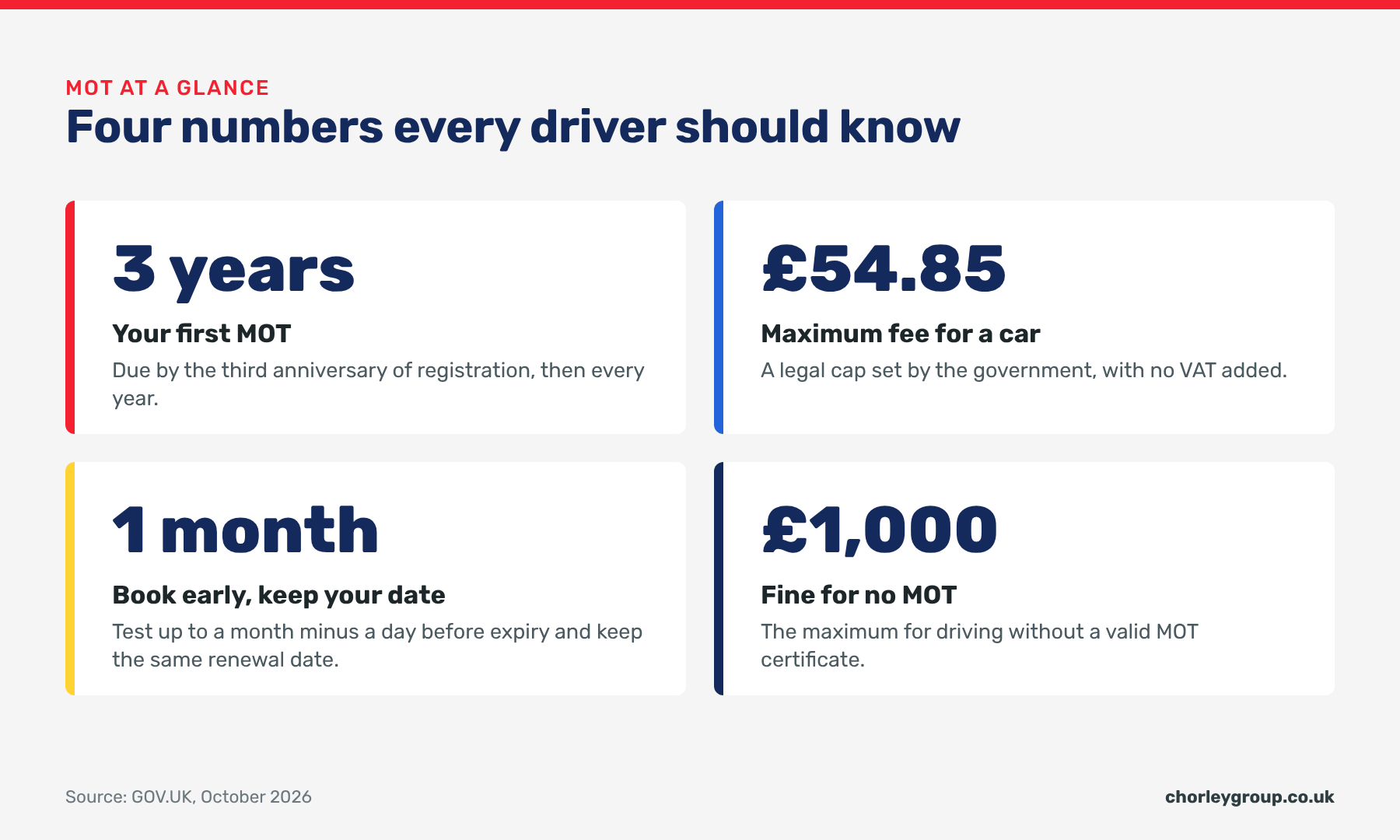
- First MOT: by the third anniversary of registration, then every year
- Check your date: gov.uk/check-mot-history, number plate only
- Book early: up to a month minus a day before expiry and keep the same renewal date
- Maximum fee for a car: £54.85, no VAT added
- Fine for no MOT: up to £1,000
- Fail rate: 27.5% of cars and small vans failed first time in 2025 to 2026 (DVSA)
- Most common fail: lights and electrics, on just over 1 in 10 tests
How do I check when my MOT is due?
There are three easy ways, and none of them costs anything.
- Use the GOV.UK MOT history checker. Go to gov.uk/check-mot-history and enter your registration. It shows when the next MOT is due, whether each past test passed or failed, the mileage recorded at each one and any minor problems the tester noted. Results for cars and vans go back to 2005.
- Look at your last MOT certificate. The expiry date is printed on it. If you've lost it, the history checker lets you download a copy for tests done in England, Scotland or Wales.
- Sign up for a free reminder. The GOV.UK MOT reminder service sends a text or email one month before your car's MOT is due. Two minutes to set up, and you never have to think about it again.
One tip from our workshop: the history checker is also the best free tool there is when you're buying a used car. The advisories tell you what the last tester was keeping an eye on, and a mileage that jumps around between tests is a reason to ask questions.
When is a car's first MOT due?
A new car needs its first MOT by the third anniversary of its registration. After that, it needs one every year.
So a car registered on 1 March 2024 needs its first MOT by 1 March 2027. If you're not sure of your registration date, it's on your V5C logbook, or the MOT history checker will show you the due date anyway.
There was talk of moving the first MOT to four years. The government consulted on it in 2023 and decided in January 2024 to keep it at three years and annual after that (RAC, January 2024).
A few vehicles are different:
- Taxis, ambulances and minibuses with 9 or more passenger seats need their first MOT at one year old (GOV.UK).
- Cars built or first registered more than 40 years ago don't need an MOT, as long as they haven't had substantial changes such as a different engine, chassis, body or axles (GOV.UK).
- Northern Ireland has its own rules, set out on nidirect.
How early can I get my MOT done?
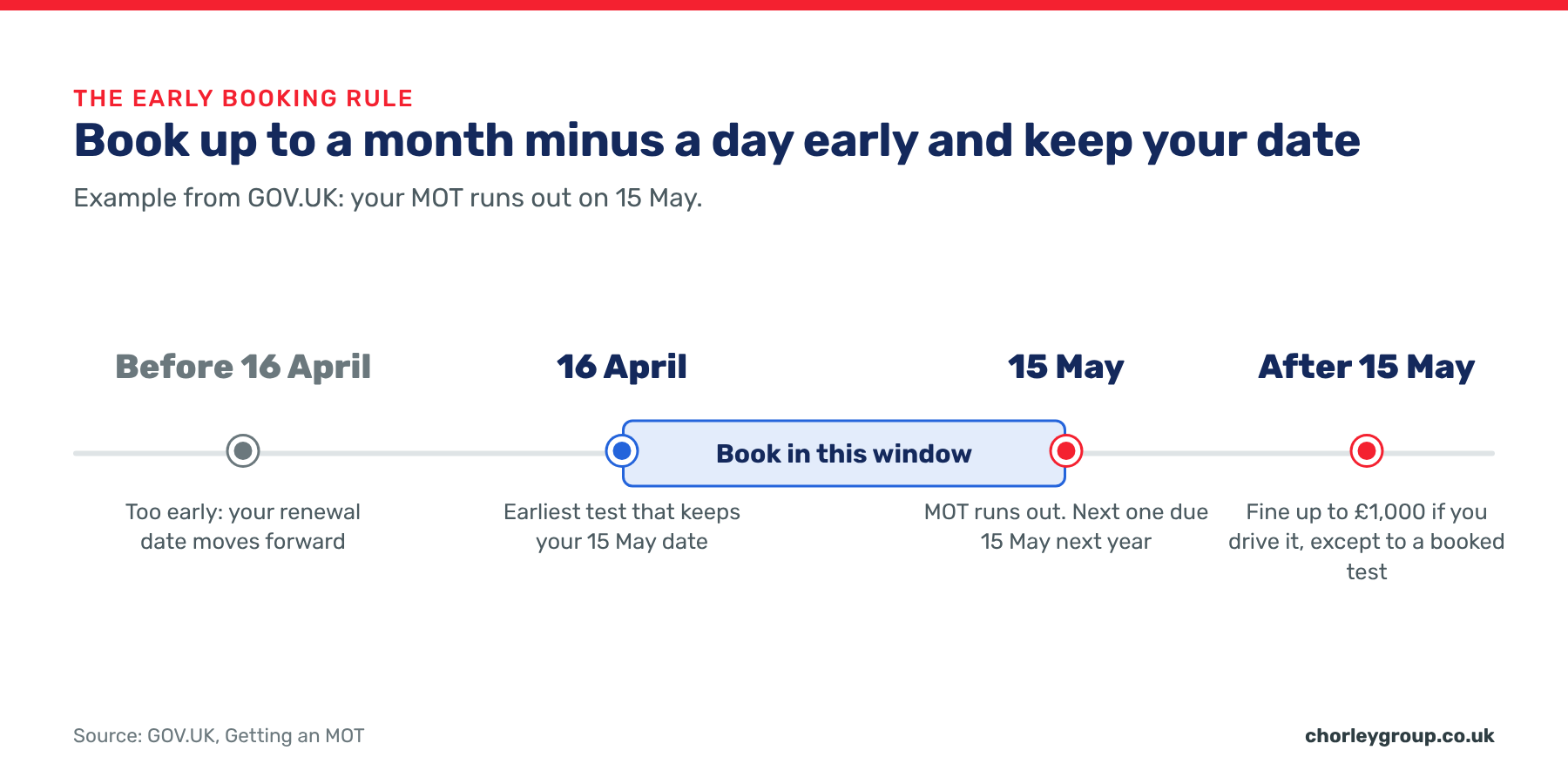
You can get an MOT up to a month minus a day before it runs out and keep the same renewal date. GOV.UK's own example: if your MOT runs out on 15 May, the earliest you can test and keep that date is 16 April (GOV.UK).
Go any earlier and your new MOT runs for a year minus a day from the day it passes, so you lose a few weeks.
Booking in that month-long window gives you breathing space. If something fails, you've still got a valid MOT while it's put right. Leave it to the last day and a failed bulb can take the car off the road.
How much does an MOT cost?
The most a test centre can charge for a car MOT is £54.85. That's a legal maximum set by the government, and no VAT is added on top (GOV.UK).
Vehicle | Maximum MOT fee | First MOT due |
|---|---|---|
Car (up to 8 passenger seats) | £54.85 | 3 years |
Motorcycle | £29.65 | 3 years |
Goods vehicle up to 3,000kg (most car-derived and small vans) | £54.85 | 3 years |
Goods vehicle over 3,000kg up to 3,500kg (large vans) | £58.60 | 3 years |
Passenger vehicle, 9 to 12 seats | £57.30 | 1 year |
Source: GOV.UK MOT test fees, October 2026.
Garages can charge less than the maximum, but not more. What the fee doesn't include is any repair work if the car fails, which is where the real cost sits. That's why the next two sections matter more than the price of the test itself.
Driving a larger van? Those over 3,000kg need a class 7 test, and we cover what that involves in our class 7 MOT guide.
What are the most common MOT fails?
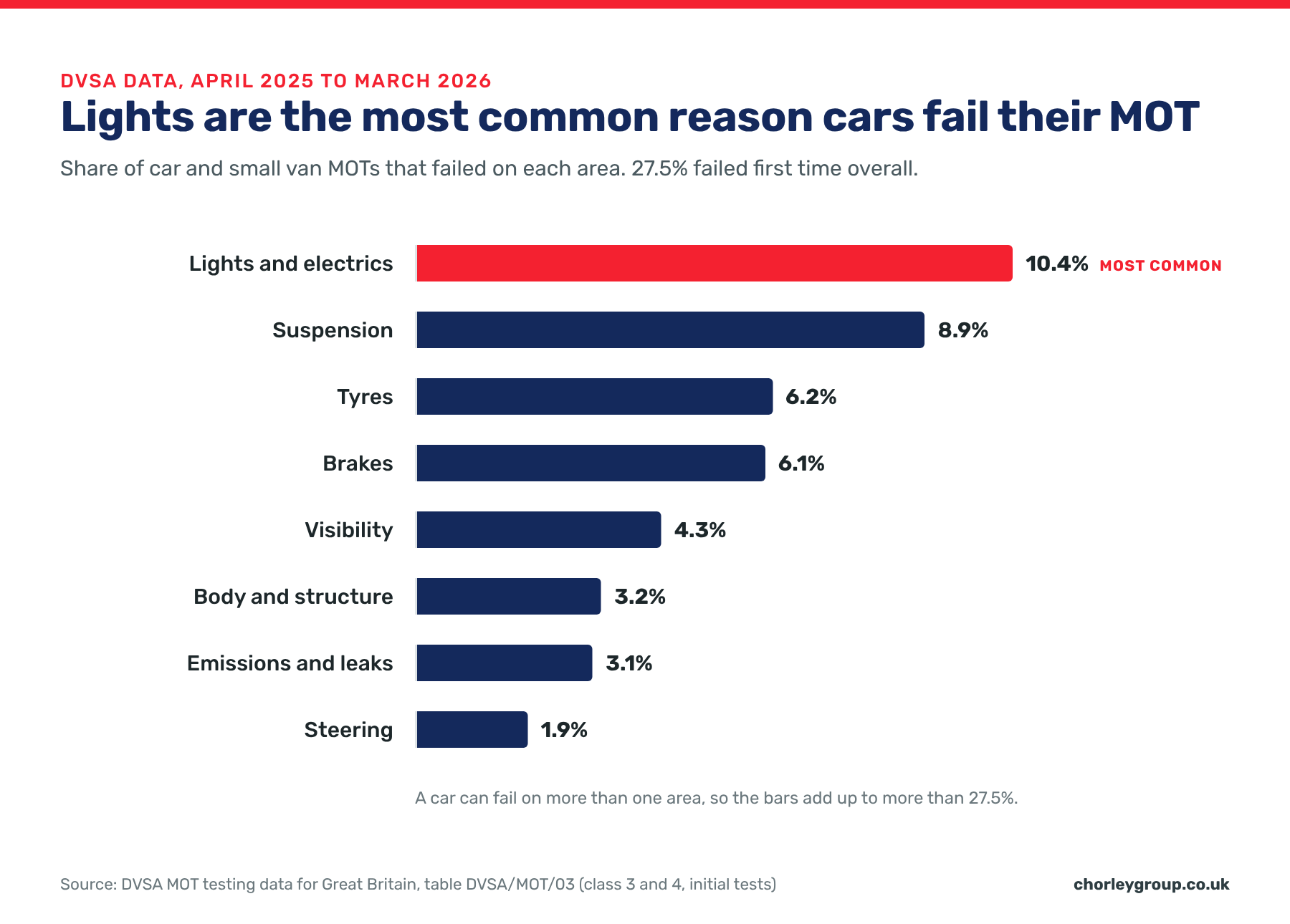
In 2025 to 2026, 27.5% of cars and small vans failed their MOT first time in Great Britain. Lights and electrics were the most common reason, found on 10.4% of all tests, followed by suspension (8.9%), tyres (6.2%) and brakes (6.1%). That's from the DVSA's own MOT testing data, covering April 2025 to March 2026.
Rank | Fail category | Share of MOTs failed on it | Share of all failure defects |
|---|---|---|---|
1 | Lights, reflectors and electrics | 10.4% | 24.9% |
2 | Suspension | 8.9% | 20.5% |
3 | Tyres | 6.2% | 12.9% |
4 | Brakes | 6.1% | 15.2% |
5 | Visibility | 4.3% | 7.7% |
6 | Body, chassis and structure | 3.2% | 6.3% |
7 | Noise, emissions and leaks | 3.1% | 5.9% |
8 | Steering | 1.9% | 3.6% |
Source: DVSA MOT testing data for Great Britain, table DVSA/MOT/03, class 3 and 4 vehicles, initial tests, April 2025 to March 2026.
The two figures worth remembering
Tyres and brakes cause 89% of dangerous faults. A dangerous fault is the most serious kind, where the car shouldn't be driven until it's fixed. Lights fail more cars, but tyres and brakes account for most of the faults serious enough to stop a car being driven.
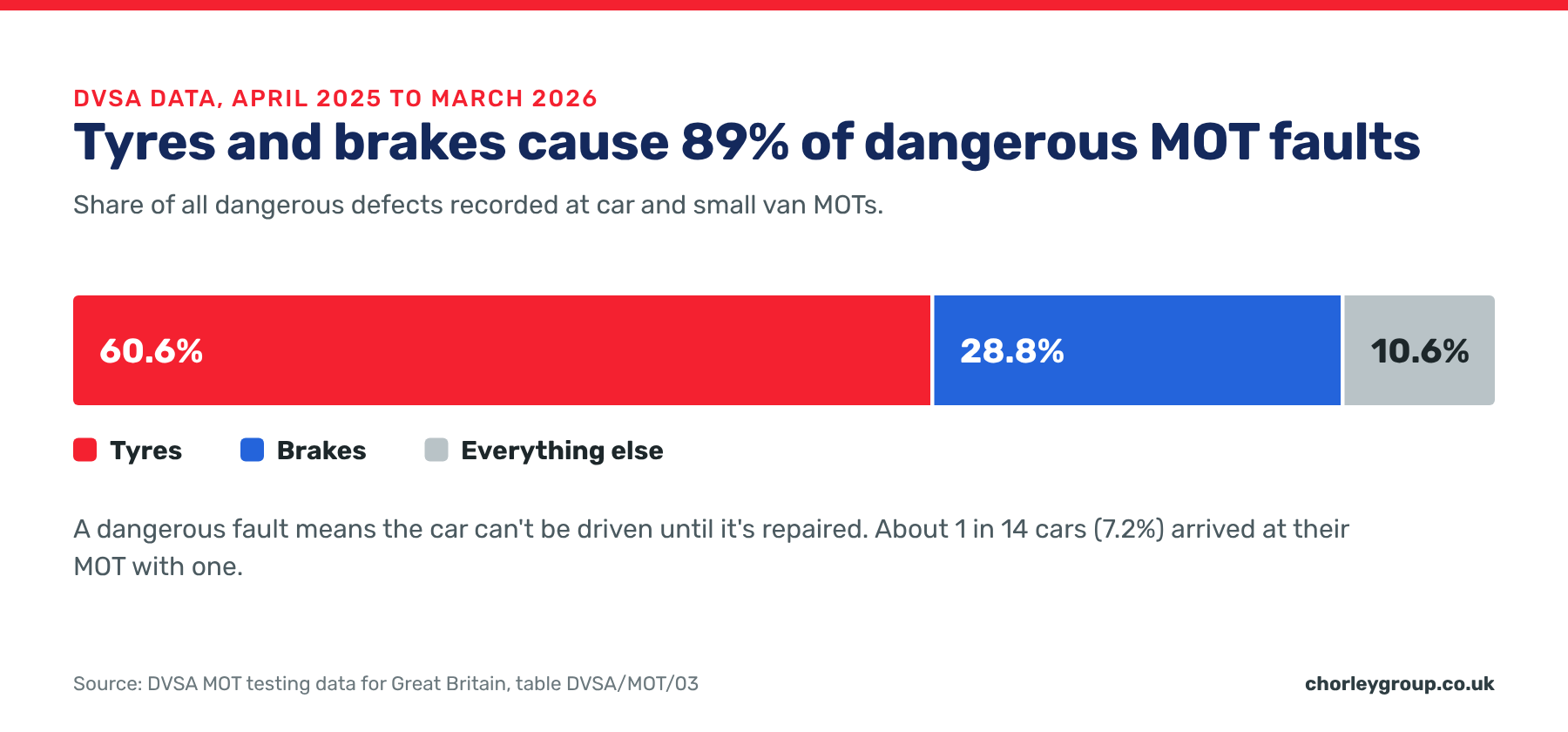
About 1 in 14 cars arrived with a dangerous fault. That's 7.2% of all tests, and it's the best argument there is for a quick check before you book.
What each fail usually means in practice
- Lights and electrics. Often a blown bulb: a brake light, an indicator, a number plate lamp. Usually cheap to fix.
- Suspension. Typical faults are worn bushes, broken coil springs and leaking shock absorbers. A laser wheel alignment afterwards protects your tyres.
- Tyres. Tread below the legal 1.6mm, cuts, bulges, or the wrong size. Our tyre tread depth guide shows the 20p test.
- Brakes. Worn pads and discs, uneven braking, and warning lights. Not sure what a light means? Start with our guide to ABS.
- Visibility. A chip in the driver's line of sight, wipers that smear, an empty washer bottle.
How to avoid an MOT fail: a 10-minute check
The DVSA has said that nearly half of all faults found at MOTs could be avoided with simple checks and basic maintenance (DVSA, 2017). The figure is from older data, but the fail categories haven't changed much since, so the advice still stands.
Before your MOT, run through this on your drive:
- Lights. Walk round with the lights, indicators and hazards on. Reverse up to a garage door or window to check the brake lights, or ask someone to press the pedal.
- Number plate lamp. Easy to forget, and a fail if it's the only one and it's out.
- Tyres. At least 1.6mm of tread, no cuts or bulges, and pumped up to the right pressure. The spare isn't checked.
- Wipers and washers. Blades that clear the screen cleanly, and a full washer bottle.
- Windscreen. Look for chips in the area in front of the driver.
- Warning lights. Start the car and check nothing stays on. Brake, ABS, airbag, power steering and tyre pressure lights are all checked.
- Horn. Give it a quick press.
- Seatbelts. Pull each one sharply. It should lock, then retract smoothly.
- Clear view. Take down anything that blocks your view of the road, like stickers, toys or air fresheners.
- Fuel cap key. The tester has to open the fuel cap, so bring the key if yours locks.
Ten minutes, and it covers the things that fail the most cars.
What happens if my car fails its MOT?
If your car fails with a dangerous fault, you can't drive it away until it's repaired. If the fault is major rather than dangerous, and your old MOT hasn't run out yet, you can drive it away, but it still has to be roadworthy every time it's on the road (GOV.UK).
Here's how the four types of result work:
Result | Pass or fail? | Can you drive it? |
|---|---|---|
Dangerous | Fail | No. Fine up to £2,500, a possible ban and 3 penalty points if you do. |
Major | Fail | It is not advised! Even if your old MOT is valid, police can still fine or prosecute you if your car is deemed dangerous or unfit for the road. |
Minor | Pass | Yes, but get it fixed soon. |
Advisory | Pass | Yes. Keep an eye on it before it becomes a fail next year. |
Can I drive my car if the MOT has expired?
Only to a pre-booked MOT test, or to or from somewhere it's being repaired. Otherwise, driving without a valid MOT can mean a fine of up to £1,000 (GOV.UK).
If you've spotted the date has passed, book the test first, then drive straight there.
Is an MOT the same as a service?
No, and it's one of the most common mix-ups we hear at the service desk.
An MOT is a legal safety check. A service is maintenance. The MOT checks that your car meets the minimum legal standard on the day. It doesn't look at the engine, clutch or gearbox at all (GOV.UK). A service changes the oil and filters, checks the parts that wear, and keeps your manufacturer warranty and service history in order.
MOT | Service | |
|---|---|---|
Required by law | Yes, yearly from 3 years old | No, but sticking to the schedule protects your warranty |
Checks the engine, clutch and gearbox | No | Yes |
Changes oil and filters | No | Yes |
Price | Capped at £54.85 for a car | Depends on the car and the service |
What you get | Pass or fail certificate | A healthier car and a stamped service history |
Do electric cars need an MOT?
Yes. Electric cars follow exactly the same MOT rules as petrol and diesel: first test at three years, then every year, same £54.85 maximum fee. The only electric exemption on GOV.UK is for electric goods vehicles registered before 1 March 2015 (GOV.UK).
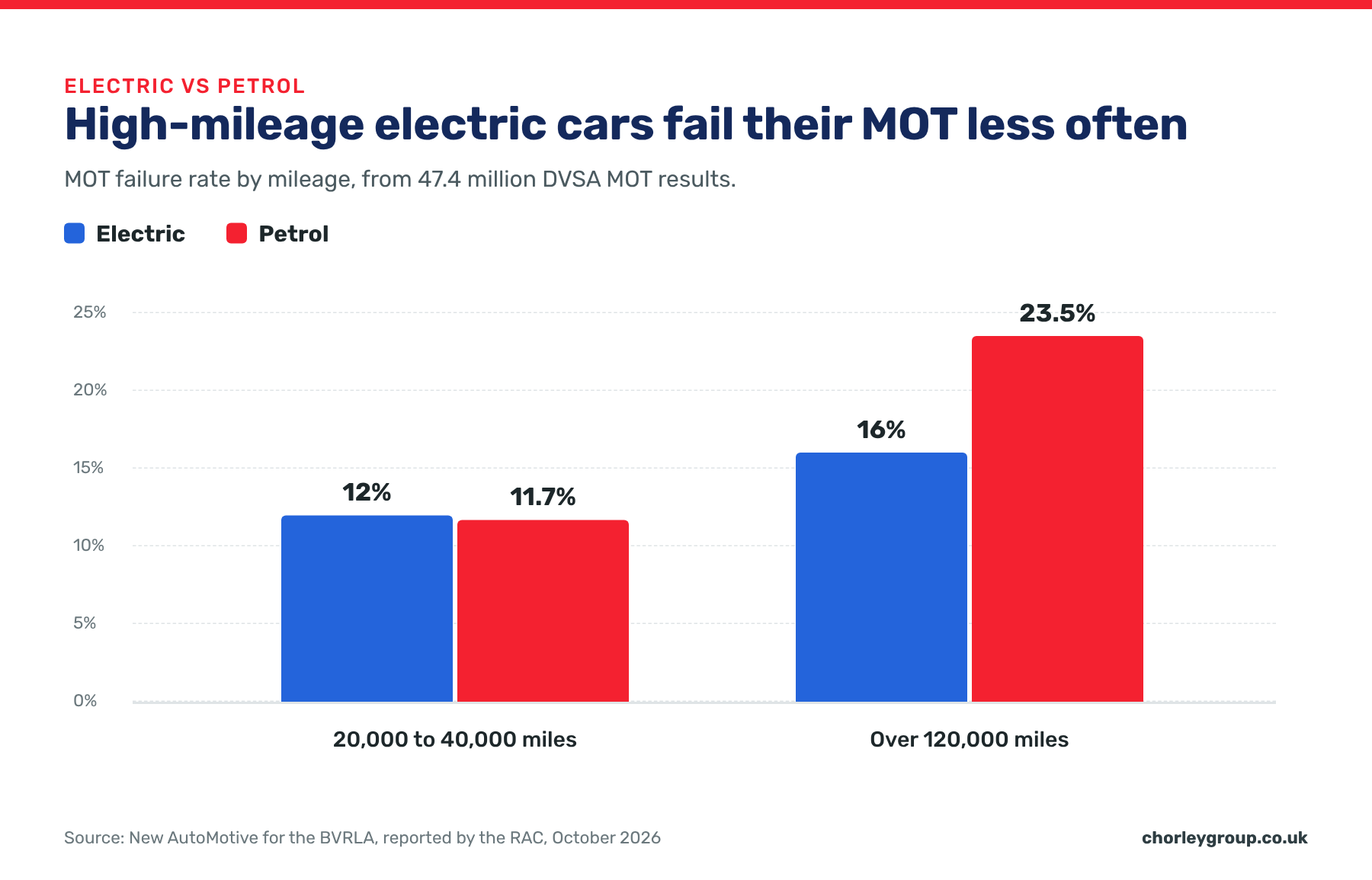
There's some good news on fail rates, though. A study of 47.4 million DVSA MOT results, carried out by New AutoMotive for the BVRLA and reported this month, found that at over 120,000 miles 16% of electric cars failed, against 23.5% of petrol cars (RAC, October 2026). At lower mileages there's little in it: 12% against 11.7% between 20,000 and 40,000 miles. Fewer moving parts, and regenerative braking taking some of the work off the brake pads, are the likely reasons the gap opens up as the miles go on.
If you're thinking about making the switch, have a look at our used electric cars across the North West.

Book your MOT with Chorley Group
Book at your nearest Chorley Group workshop in Lancashire or Greater Manchester, and our technicians will talk you through anything they find in plain English, with no jargon and no pressure.
Frequently asked questions
Your MOT is due on the expiry date on your last MOT certificate. A new car's first MOT is due by the third anniversary of its registration, then every year. Check your date for free at gov.uk/check-mot-history using your number plate.
The maximum fee for a car MOT is £54.85, with no VAT added. Motorcycles are capped at £29.65. Garages can charge less, but not more.
No. The MOT doesn't check the condition of the engine, clutch or gearbox. That's what a service is for.
Not if it failed with a dangerous fault: that can mean a fine of up to £2,500, 3 penalty points and a ban.
Related articles


Diesel Hits £2 a Litre: What It Means for Your Car's Value and the Switch to Electric
Diesel hit a record UK average of 200.01p a litre on 2 October 2026, the highest price ever recorded, which means filling a typical 55-litre family car now costs £110.01, or £31.70 more than at the end of February.
Posted on 5 October 2026Aaron Williams
Read full article